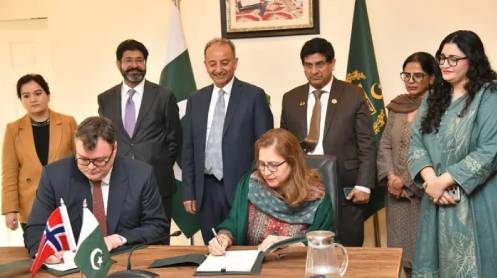
ISLAMABAD: Pakistan and Norway have signed their first bilateral carbon trading agreement under Paris Agreement Article 6.2, marking a major step toward accessing international carbon markets and climate finance.
The memorandum of understanding, signed under the Ministry of Climate Change and Environmental Coordination, signals Pakistan’s transition from policy planning to implementation in carbon trading. Federal Minister Musadik Malik termed the agreement a milestone, stating it would move the country from “readiness to execution” in climate cooperation.
Under the deal, Pakistan will develop projects generating carbon credits across key sectors including clean energy, agriculture, transport, and waste management. These emission reductions will be transferred to Norway through the framework of Internationally Transferred Mitigation Outcomes (ITMOs).
Officials believe the agreement will help attract foreign investment at a time when Pakistan faces increasing climate challenges such as floods, heatwaves, and extreme weather events. Malik emphasized that carbon markets should support economic transition, job creation, technology transfer, and community benefits rather than serve as an end in themselves.
Pakistan has already approved national carbon trading policy guidelines in January 2025 and is now working on regulatory systems and reporting frameworks to operationalise the market. The country’s strong mitigation potential in renewable energy and other sectors is expected to draw international investors.
Speaking at the signing ceremony, Norway’s Ambassador to Pakistan, Per Albert Ilsaas, said the agreement marks a new phase of bilateral climate cooperation. He noted that Norway aims to achieve climate neutrality by 2030 and plans to purchase carbon credits not just to meet, but to exceed its climate targets.
He highlighted Norway’s Global Emission Reduction Initiative, a $1.5 billion programme launched in 2024, which will channel carbon finance to countries like Pakistan. Norway is also looking to expand collaboration beyond individual projects to sector-wide initiatives in renewable energy, industry, and agriculture.
The ambassador added that Norway has signed similar agreements with multiple countries and aims to acquire 15 million carbon credits by 2030, while encouraging Pakistan to develop a broader pipeline of climate projects.
The agreement is expected to enhance Pakistan’s access to climate finance, boost private-sector participation, and support the country’s transition toward a low-carbon and sustainable economy.